
Copperbelt Province, Zambia
Mbengwe Copper Complex
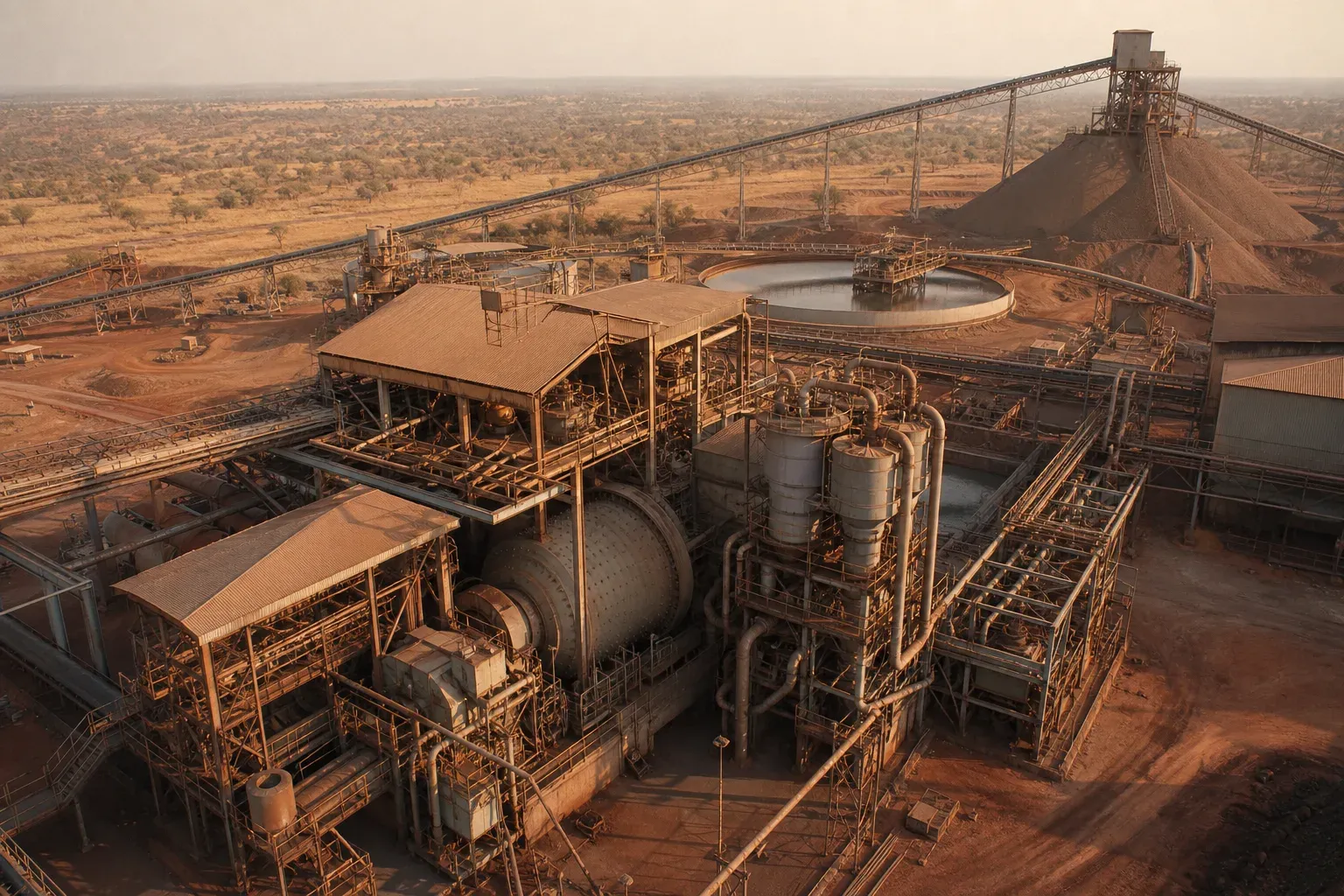
The group’s largest asset and the source of roughly two thirds of group copper. Mbengwe combines a mature open pit, a ramping underground mine and two processing routes on a single licence area in the Zambian Copperbelt.
- FY2025 copper
- 96.4 kt
- Ore reserve
- 182 Mt @ 1.12% Cu
- Mine life
- 18 years
- C1 cash cost
- US$1.71/lb
Overview
Mbengwe sits on the south-eastern limb of the Zambian Copperbelt, on ground that had been mapped, drilled and then abandoned three times between 1968 and 1998. Quintel acquired the licences in 2004 for a modest cash consideration and a commitment to rehabilitate the legacy waste dumps left by earlier operators. The first cathode was produced three years later from oxide material that previous owners had classified as waste.
The complex today has two independent processing routes. A solvent extraction and electrowinning (SX-EW) plant treats oxide and transition ore from the open pit and heap leach pads, producing LME Grade A registered cathode on site. A 11.5 Mtpa sulphide concentrator, commissioned in 2012, produces a clean copper concentrate grading 27–29% Cu that is trucked to smelters in Zambia and to the port of Walvis Bay for export.
In FY2025 Mbengwe produced 96.4 kt of contained copper, 65% of group copper output, at a C1 cash cost of US$1.71 per pound. The asset accounted for 38% of group revenue and employs 2,150 people directly, of whom 97% are Zambian nationals and 58% are recruited from within Copperbelt Province.
Geology and resource
Mineralisation is hosted in the Neoproterozoic Katanga Supergroup, in the classic Copperbelt stratigraphic position at the base of the Kitwe Formation. The ore body is a stratabound, sediment-hosted deposit with chalcopyrite and bornite as the dominant sulphides below the weathering front, and malachite, chrysocolla and pseudomalachite in the oxide cap that extends to between 60 and 110 metres below surface.
The deposit has been traced over 7.4 kilometres of strike and remains open down-dip to the north-east. Drilling density is 40 m by 40 m in the measured category and 80 m by 80 m in the indicated category, with 612,000 metres of diamond and reverse circulation drilling in the database as at 31 December 2025. Mineral resources and ore reserves are estimated in accordance with the JORC Code (2012) and signed off by an independent Competent Person.
Mineral resources and ore reserves
| Category | Tonnes (Mt) | Grade (% Cu) | Contained Cu (kt) |
|---|---|---|---|
| Proved reserve | 104.0 | 1.19 | 1,238 |
| Probable reserve | 78.0 | 1.03 | 803 |
| Total ore reserve | 182.0 | 1.12 | 2,041 |
| Measured resource | 148.0 | 1.14 | 1,687 |
| Indicated resource | 192.0 | 0.98 | 1,882 |
| Inferred resource | 86.0 | 0.91 | 783 |
Mineral resources are reported inclusive of ore reserves. Reserves are estimated at a copper price of US$3.60/lb and a cut-off grade of 0.42% Cu for open pit and 0.95% Cu for underground.
Mining
The open pit is a conventional truck-and-shovel operation running a fleet of 220-tonne haul trucks and 34 m³ hydraulic excavators against a life-of-mine strip ratio of 4.6:1. Blasting uses electronic detonators exclusively, which reduced vibration complaints from the neighbouring Chibale settlement by 71% after their introduction in 2019.
Underground mining at Mbengwe North uses sub-level open stoping with paste backfill. The decline was collared in 2018 and reached the first production level in 2021. Development advanced 6,240 metres in FY2025 and the mine reached a 3.1 Mtpa run rate in the fourth quarter. Underground now supplies 27% of concentrator feed at nearly double the open pit grade, and that share rises to 61% by 2031 as the pit approaches its final shell.
Nine of the twelve underground production drills are operated remotely from a control room on surface. Fatigue-monitoring technology is fitted to every haul truck in the open pit fleet, and the operation has run 41 consecutive months without a lost-time injury in the mining department as at 31 December 2025.
Processing and product
Oxide and transition ore is crushed to 12 mm, agglomerated with acid and stacked on lined heap leach pads. Pregnant leach solution is treated in a two-stage SX circuit and electrowon into cathode with a nameplate capacity of 62 ktpa. Cathode from Mbengwe is registered as LME Grade A under brand code QTL-MBW and has been continuously registered since 2009.
Sulphide ore is treated in the concentrator through SAG and ball milling to a P80 of 106 microns, followed by rougher, cleaner and scavenger flotation. Concentrate grades 27–29% copper with low arsenic (below 0.05%) and negligible fluorine, which makes it a preferred blending feed for smelters with tight penalty-element limits. Overall copper recovery averaged 89.4% in FY2025.
Operating performance
| Metric | FY2023 | FY2024 | FY2025 |
|---|---|---|---|
| Ore milled (Mt) | 9.8 | 10.6 | 11.2 |
| Head grade (% Cu) | 0.94 | 0.97 | 1.02 |
| Recovery (%) | 87.8 | 88.6 | 89.4 |
| Copper produced (kt) | 81.1 | 90.8 | 96.4 |
| C1 cash cost (US$/lb) | 1.88 | 1.79 | 1.71 |
| Sustaining capital (US$m) | 84 | 96 | 103 |
Infrastructure and energy
Mbengwe is grid-connected but does not rely on the grid alone. Hydrological drought on the Zambezi system in 2019 and 2024 made energy resilience a board-level issue for the complex.
- Grid supply: 132 kV connection to the national utility under a bilateral supply agreement, providing up to 78 MW of predominantly hydroelectric power.
- Solar: a 45 MW photovoltaic plant energised in 2024 on rehabilitated waste rock ground, supplying 19% of site electricity and displacing an estimated 41 kt CO₂e a year.
- Battery storage: 22 MWh of lithium-iron-phosphate storage smooths the solar profile and carries critical loads through grid dips.
- Backup generation: 32 MW of diesel capacity retained for critical loads only — dewatering, ventilation and refrigeration — and run for 412 hours in FY2025.
- Logistics: cathode and concentrate move by road to the Zambia Railways network at Kitwe, and via the Walvis Bay corridor to the Atlantic coast for export.
- Water: a closed-circuit water balance recycling 82% of process water, with raw water abstraction licensed at 4.1 million cubic metres a year.
Tailings and closure
Mbengwe operates two tailings storage facilities. TSF1 is a legacy upstream-raised facility inherited with the licences; it was decommissioned in 2016, capped and is now 94% vegetated with indigenous grass species. TSF2 is a downstream-raised facility with a composite liner, underdrainage and a piezometer network reporting to a live dashboard reviewed weekly by the Engineer of Record.
Both facilities are covered by the group’s Global Industry Standard on Tailings Management conformance programme, with independent tailings review board inspections twice a year. The consequence classification for TSF2 is “High” and the facility is designed and audited to that standard, including a dam break analysis published in summary form in the annual sustainability report.
The closure provision for Mbengwe stood at US$118 million at year end, calculated on a third-party cost basis and funded progressively into a ring-fenced rehabilitation trust held in Zambia. Progressive rehabilitation returned 214 hectares to a self-sustaining land use during FY2025.
Community and contribution
Mbengwe paid US$164 million in taxes, mineral royalties and other government payments in FY2025, and spent US$392 million with Zambian-registered suppliers, of which US$88 million went to businesses owned within the Copperbelt Province.
The Mbengwe Community Trust holds a 5% equity interest in the operation on behalf of the six chiefdoms whose land the licence area overlaps. Dividends flow to a governance committee chaired by a rotating traditional authority representative, with an independent auditor and published accounts. Since 2016 the Trust has funded a 42-bed maternity wing, three primary schools, 18 boreholes and a technical training centre that has certified 1,340 artisans, 62% of whom now work outside Quintel.
Outlook
Guidance for FY2026 is 100–108 kt of copper at a C1 cash cost of US$1.66–1.74 per pound. The principal capital project is the second phase of the underground materials handling system, a US$142 million investment approved in 2025 that adds a crusher and conveyor decline and removes 41 trucks from the ramp.
Exploration in FY2026 focuses on the north-east down-dip extension, where three deep holes drilled in 2025 intersected mineralisation at grades consistent with the current reserve between 780 and 940 metres below surface. A resource update covering that extension is scheduled for the first half of 2027.
Asset history
How Mbengwe got here
- 2004
Quintel acquires the dormant Mbengwe licences and legacy oxide stockpiles.
- 2007
First copper cathode produced from the 45 ktpa SX-EW plant.
- 2012
Concentrator commissioned, unlocking the sulphide horizon below the oxide cap.
- 2018
Mbengwe North decline collared; underground development begins.
- 2021
Tailings storage facility raised to GISTM design standards under independent review.
- 2024
45 MW solar plant energised under a 20-year power purchase agreement.
- 2025
Underground reaches 3.1 Mtpa run rate; complex passes 96 kt annual copper for the first time.
Reporting standard
Mineral resources and ore reserves for this asset are estimated in accordance with the JORC Code (2012) and reviewed annually by an independent Competent Person. Resources are reported inclusive of reserves. Production figures are as reported in the FY2025 Annual Review.
Full resource and reserve statementLocation
Where this asset sits in the portfolio
Schematic map. Marker positions indicate the operating district, not a licence boundary.
- Producing
- Development
- Exploration
- Mbengwe Copper ComplexCopperbelt Province, Zambia · CopperProducing
- Lubumba Copper-Cobalt OperationLualaba Province, Democratic Republic of the Congo · Copper, CobaltProducing
- Asankran Gold MineWestern North Region, Ghana · GoldProducing
- Tazoult Silver MineAnti-Atlas, Drâa-Tafilalet, Morocco · SilverProducing
- Gamagara Manganese MineNorthern Cape, South Africa · ManganeseProducing
- Nyanga Manganese OperationHaut-Ogooué Province, Gabon · ManganeseProducing
- Fatala Bauxite OperationBoké Region, Guinea · BauxiteProducing
- Bagoé Gold ProjectSavanes District, Côte d'Ivoire · GoldDevelopment
- Erongo Copper ExplorationErongo Region, Namibia · CopperExploration
Seven operating mines, two development assets and 9 offices across nine countries. Every operation is managed by Quintel; we do not hold non-operated minority interests.
Enquiries
Questions about Mbengwe?
Community, procurement, media and offtake enquiries relating to this operation route to a named contact in the country where it operates.