
Northern Cape, South Africa
Gamagara Manganese Mine
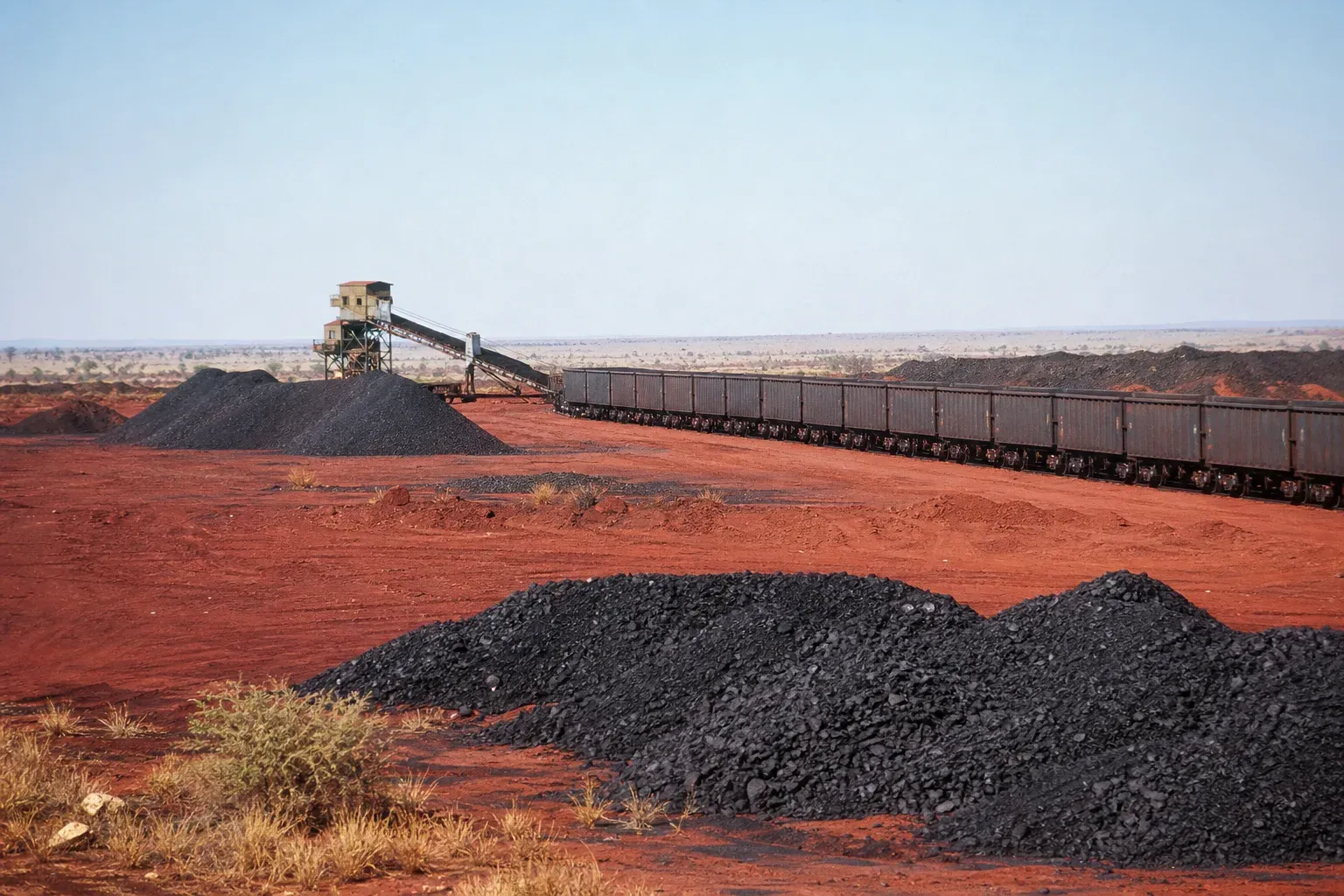
A long-life, low-cost manganese mine in the Kalahari Manganese Field, the largest land-based manganese resource in the world. Gamagara supplies steel alloy producers in Asia and Europe.
- FY2025 ore
- 1.18 Mt
- Ore reserve
- 78 Mt @ 38.4% Mn
- Mine life
- 24 years
- Rail allocation
- 1.4 Mtpa
Overview
The Kalahari Manganese Field in South Africa’s Northern Cape contains around 70% of the world’s identified land-based manganese resources. Gamagara sits on the western limb of that field, on a mining right renewed in 2023 and valid to 2049.
The operation mines a shallow open pit and, since 2018, an underground bord-and-pillar mine accessed by a decline. Ore is crushed, screened and upgraded through a dense media separation plant into lumpy, fines and sinter-feed products grading between 38% and 44% manganese. Product is railed 860 kilometres to the ports of Ngqura and Port Elizabeth for export.
Manganese is unglamorous and indispensable: around 90% of world production goes into steel, where there is no commercial substitute for its role as a deoxidiser and alloying element. Gamagara produced 1.18 Mt in FY2025, roughly 61% of group manganese output.
Geology and resource
Mineralisation occurs in the Hotazel Formation of the Palaeoproterozoic Transvaal Supergroup, in three stratiform manganese-bearing zones interbedded with banded iron formation. Gamagara exploits the lowermost and thickest zone, which averages 4.2 metres in mining thickness and dips gently at 4 to 7 degrees — geometry that suits mechanised bord-and-pillar mining almost perfectly.
The ore is a braunite-hausmannite-kutnohorite assemblage typical of the western Kalahari field, with low phosphorus (0.04% P) and low iron relative to eastern-field ores. Those two characteristics command a consistent premium from alloy producers and are the reason the operation sells forward on multi-year contracts rather than into the spot market.
Mineral resources and ore reserves
| Category | Tonnes (Mt) | Mn (%) | Fe (%) | P (%) |
|---|---|---|---|---|
| Proved reserve | 46.0 | 39.1 | 5.2 | 0.04 |
| Probable reserve | 32.0 | 37.4 | 5.6 | 0.04 |
| Total ore reserve | 78.0 | 38.4 | 5.4 | 0.04 |
| Measured and indicated resource | 141.0 | 37.8 | 5.7 | 0.04 |
| Inferred resource | 38.0 | 36.9 | 6.1 | 0.05 |
Reported under SAMREC as required for a South African asset; SAMREC and JORC are materially equivalent reporting codes.
Mining and processing
Underground mining is fully mechanised bord-and-pillar on a 7.5-metre bord width with 8-metre square pillars, giving an extraction ratio of 62%. Continuous miners are used in the softer ore zones and drill-and-blast in the harder banded horizons. The decline is equipped with a conveyor, eliminating truck haulage from the ramp.
The dense media separation plant, commissioned in 2020, upgrades run-of-mine ore by 3.1 percentage points of manganese and rejects most of the banded iron formation dilution. Product splits are approximately 54% lumpy (25–75 mm), 31% fines and 15% sinter feed, with the mix adjusted quarterly to customer nominations.
Dust is the dominant occupational hygiene risk. Every continuous miner is fitted with on-board dust suppression, all underground personnel carry personal dust monitors on a rotating sampling programme, and the operation has reported no new cases of occupational lung disease since it came into Quintel ownership.
Operating performance
| Metric | FY2023 | FY2024 | FY2025 |
|---|---|---|---|
| Run-of-mine ore (Mt) | 1.32 | 1.41 | 1.49 |
| Saleable product (Mt) | 1.04 | 1.11 | 1.18 |
| Average product grade (% Mn) | 39.8 | 40.2 | 40.4 |
| Railed tonnage (Mt) | 0.98 | 1.08 | 1.17 |
| Cash cost (US$/t FOB) | 112 | 108 | 104 |
Logistics: the binding constraint
For a bulk commodity mined 800 kilometres from the sea, rail capacity determines production more than the orebody does. South African bulk rail performance has been a well-documented national problem, and Gamagara has been affected by it like every other producer in the field.
The group’s response has been to stop treating rail as somebody else’s problem. Quintel co-invested in a private siding and rapid-loading facility at the mine that cuts train turnaround from 14 hours to 5, funded the refurbishment of 240 wagons under a long-term lease-back, and staffs a joint operations centre with the rail operator. In FY2025 the operation railed 99% of the tonnage it produced, against a field average materially below that.
A road-to-port contingency exists for up to 180 kt a year but is used only to clear stockpile after rail interruptions, because it costs roughly three times as much per tonne and carries a materially worse safety and emissions profile.
Transformation and community
South African mining law requires more than the payment of taxes. Gamagara operates under an approved Social and Labour Plan and a mining right that carries binding ownership, procurement, employment equity and human settlement commitments under the Mining Charter.
The B-BBEE consortium holds 21% and the employee share trust 5%, meaning 26% of the operation is held by historically disadvantaged South Africans. The employee trust has paid a distribution in each of the last six years. Of managerial positions, 64% are held by historically disadvantaged South Africans and 38% by women.
The operation spent R2.1 billion with South African suppliers in FY2025, of which R680 million went to businesses in the John Taolo Gaetsewe and ZF Mgcawu district municipalities. Housing remains the most persistent local issue; Quintel has funded 412 serviced residential stands and converted all single-sex hostel accommodation to family units, completed in 2022.
Outlook
Guidance for FY2026 is 1.20–1.28 Mt of saleable product. The underground mine will add a fourth production section in the second half of the year, taking underground to 78% of total output and allowing the open pit to enter final rehabilitation from 2028.
With 24 years of reserves and the lowest cash cost in the group’s portfolio, Gamagara’s strategic role is stability: it is the asset expected to generate cash through the bottom of the cycle when copper and gold do not.
Asset history
How Gamagara got here
- 2013
Quintel acquires a 74% interest alongside a B-BBEE consortium.
- 2015
Open pit restarted; first ore railed to Port Elizabeth.
- 2018
Underground decline completed; bord-and-pillar production begins.
- 2020
Dense media separation plant commissioned, lifting product grade by 3.1 points.
- 2023
Mining right renewed to 2049 with an approved social and labour plan.
- 2025
Long-term rail allocation increased to 1.4 Mtpa under a multi-year agreement.
Reporting standard
Mineral resources and ore reserves for this asset are estimated in accordance with the SAMREC Code (2016) and reviewed annually by an independent Competent Person. Resources are reported inclusive of reserves. Production figures are as reported in the FY2025 Annual Review.
Full resource and reserve statementLocation
Where this asset sits in the portfolio
Schematic map. Marker positions indicate the operating district, not a licence boundary.
- Producing
- Development
- Exploration
- Mbengwe Copper ComplexCopperbelt Province, Zambia · CopperProducing
- Lubumba Copper-Cobalt OperationLualaba Province, Democratic Republic of the Congo · Copper, CobaltProducing
- Asankran Gold MineWestern North Region, Ghana · GoldProducing
- Tazoult Silver MineAnti-Atlas, Drâa-Tafilalet, Morocco · SilverProducing
- Gamagara Manganese MineNorthern Cape, South Africa · ManganeseProducing
- Nyanga Manganese OperationHaut-Ogooué Province, Gabon · ManganeseProducing
- Fatala Bauxite OperationBoké Region, Guinea · BauxiteProducing
- Bagoé Gold ProjectSavanes District, Côte d'Ivoire · GoldDevelopment
- Erongo Copper ExplorationErongo Region, Namibia · CopperExploration
Seven operating mines, two development assets and 9 offices across nine countries. Every operation is managed by Quintel; we do not hold non-operated minority interests.
Enquiries
Questions about Gamagara?
Community, procurement, media and offtake enquiries relating to this operation route to a named contact in the country where it operates.