
Lualaba Province, Democratic Republic of the Congo
Lubumba Copper-Cobalt Operation
A high-grade oxide copper-cobalt operation in the Central African Copperbelt, and the group’s only source of cobalt. Lubumba is the most scrutinised asset in the portfolio and is run accordingly.
- FY2025 copper
- 51.8 kt
- FY2025 cobalt
- 3.85 kt
- Ore reserve
- 96 Mt @ 1.86% Cu
- Mine life
- 12 years
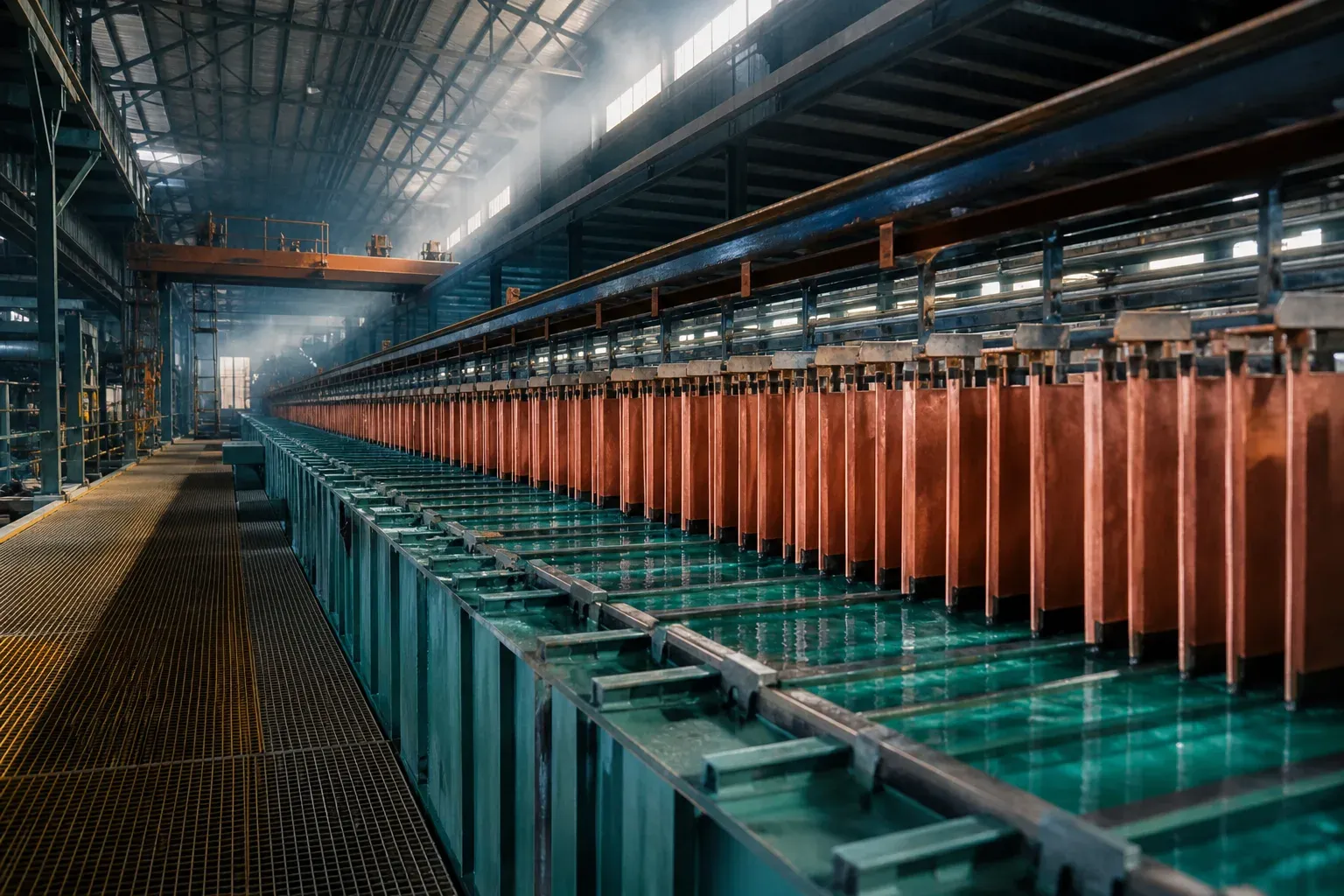
Overview
Lubumba lies in the Lualaba Province of the Democratic Republic of the Congo, within the Central African Copperbelt — the richest sediment-hosted copper province on earth and the source of roughly three quarters of world cobalt supply. Quintel entered the DRC in 2011, later than most peers and deliberately so: the group spent two years on legal, human rights and title due diligence before signing.
The operation mines oxide and transition ore from three shallow open pits, treats it through crushing, agglomeration and heap leaching, and produces copper cathode on site along with a cobalt hydroxide intermediate. In FY2025 Lubumba produced 51.8 kt of copper and 3.85 kt of contained cobalt, generating US$611 million of revenue.
The DRC carries real and well-documented risks around child labour, security force conduct, informal mining and corruption. Quintel does not claim those risks are absent from the region. What the group can evidence is what happens inside its own fence line and inside its own supply chain, and that evidence is published annually and audited by third parties.
Geology and resource
The deposit is hosted in the Mines Subgroup of the Roan Group, in the tectonically dismembered fragments that characterise the Congolese side of the Copperbelt. Mineralisation is dominantly oxide — malachite, heterogenite and pseudomalachite — developed over a primary sulphide protore to depths of 140 metres. The oxide cap is the economic target; the sulphide resource below is retained for a future development decision.
The resource is defined by 214,000 metres of drilling on a 50 m by 50 m grid over three discrete pit areas. Cobalt distribution is markedly more erratic than copper, which is a well-known feature of Katangan heterogenite mineralisation; the estimate therefore applies conditional simulation to quantify grade risk and the mine plan carries a wider cobalt guidance range as a result.
Mineral resources and ore reserves
| Category | Tonnes (Mt) | Cu (%) | Co (%) | Contained Cu (kt) | Contained Co (kt) |
|---|---|---|---|---|---|
| Proved reserve | 58.0 | 1.94 | 0.33 | 1,125 | 191 |
| Probable reserve | 38.0 | 1.74 | 0.28 | 661 | 106 |
| Total ore reserve | 96.0 | 1.86 | 0.31 | 1,786 | 297 |
| Measured and indicated resource | 164.0 | 1.71 | 0.29 | 2,804 | 476 |
| Inferred resource | 52.0 | 1.55 | 0.26 | 806 | 135 |
Reserves estimated at US$3.60/lb copper and US$14.00/lb cobalt. Cobalt recovery to hydroxide averages 74%, materially below copper recovery, and this is reflected in the mine plan.
Mining and processing
Mining is conventional open pit with 100-tonne haul trucks, a shallow average pit depth of 96 metres and a life-of-mine strip ratio of 3.1:1. Selective mining by grade control block is essential because cobalt grade varies over metres rather than tens of metres; the operation runs a portable XRF programme with 1,400 grade-control samples a week.
Ore is crushed to 15 mm, agglomerated with sulphuric acid and stacked in six-metre lifts on double-lined leach pads. Copper is recovered in a conventional SX-EW circuit producing cathode at 99.99% purity. The raffinate is neutralised and passed through a cobalt circuit where cobalt is precipitated as hydroxide at approximately 30% Co, filtered, dried and bagged for export.
Sulphuric acid — the single largest consumable — is sourced from regional smelters and, since 2023, from a group offtake arrangement that fixes 70% of annual volume, insulating the operation from the acid price spikes that have repeatedly disrupted Copperbelt producers.
Operating performance
| Metric | FY2023 | FY2024 | FY2025 |
|---|---|---|---|
| Ore stacked (Mt) | 3.6 | 3.9 | 4.1 |
| Copper head grade (%) | 1.72 | 1.79 | 1.84 |
| Copper produced (kt) | 44.9 | 48.8 | 51.8 |
| Cobalt produced (kt) | 3.12 | 3.41 | 3.85 |
| C1 cash cost, net of cobalt credits (US$/lb) | 1.54 | 1.49 | 1.41 |
| Diesel consumed (million litres) | 38.2 | 14.6 | 9.9 |
Energy and water
Until 2023 Lubumba was substantially diesel-powered, an expensive and carbon-intensive arrangement typical of the region. Quintel co-funded the refurbishment of a 220 kV substation and 84 kilometres of transmission line in partnership with the national utility, completed in 2024. Grid supply now covers 88% of demand and diesel consumption has fallen 74% in two years. The refurbished line also restored reliable supply to 21,000 households in three towns along its route.
Water for leaching is drawn from a licensed borehole field and from pit dewatering, with 71% of process water recycled. Acidic drainage from the legacy waste rock dumps inherited in 2011 is intercepted, neutralised with lime and treated before discharge; the receiving stream has met national water quality standards continuously since 2018 after failing them for most of the previous decade.
Community and contribution
Lubumba paid US$97 million in taxes, royalties and state payments in FY2025, disclosed line by line in the group’s payments-to-governments report in line with Extractive Industries Transparency Initiative principles.
Under DRC mining law, 0.3% of turnover is allocated to a community development fund governed jointly with local authorities. Quintel voluntarily contributes a further US$3.4 million a year on top of the statutory allocation. Programmes prioritise what the community councils have consistently ranked highest: potable water, school infrastructure and alternative livelihoods for households dependent on informal mining. Since 2019 the alternative livelihoods programme has supported 1,870 households into agriculture, transport and trades cooperatives.
Outlook
Guidance for FY2026 is 53–57 kt of copper and 4.0–4.3 kt of cobalt. A US$74 million debottlenecking of the leach pad stacking system will lift stacking capacity to 4.6 Mtpa from the second half of 2026.
The larger strategic question at Lubumba is the sulphide resource below the current pits. A scoping study completed in 2025 indicates a concentrator would be technically viable but would materially increase the operation’s energy and water footprint. No development decision will be taken before the results of the regional hydrogeological study due in 2027.
Asset history
How Lubumba got here
- 2011
Quintel enters the DRC through a 65% interest in the Lubumba licences.
- 2014
First cathode from a 25 ktpa SX-EW plant.
- 2017
Cobalt hydroxide circuit commissioned; first sales to European refiners.
- 2019
Full chain-of-custody assurance implemented; third-party audits begin.
- 2022
Plant expanded to 55 ktpa copper capacity.
- 2024
Grid connection reinforced, cutting diesel generation by 74%.
- 2025
Fifth consecutive year of clean Responsible Minerals Initiative assessment.
Reporting standard
Mineral resources and ore reserves for this asset are estimated in accordance with the JORC Code (2012) and reviewed annually by an independent Competent Person. Resources are reported inclusive of reserves. Production figures are as reported in the FY2025 Annual Review.
Full resource and reserve statementLocation
Where this asset sits in the portfolio
Schematic map. Marker positions indicate the operating district, not a licence boundary.
- Producing
- Development
- Exploration
- Mbengwe Copper ComplexCopperbelt Province, Zambia · CopperProducing
- Lubumba Copper-Cobalt OperationLualaba Province, Democratic Republic of the Congo · Copper, CobaltProducing
- Asankran Gold MineWestern North Region, Ghana · GoldProducing
- Tazoult Silver MineAnti-Atlas, Drâa-Tafilalet, Morocco · SilverProducing
- Gamagara Manganese MineNorthern Cape, South Africa · ManganeseProducing
- Nyanga Manganese OperationHaut-Ogooué Province, Gabon · ManganeseProducing
- Fatala Bauxite OperationBoké Region, Guinea · BauxiteProducing
- Bagoé Gold ProjectSavanes District, Côte d'Ivoire · GoldDevelopment
- Erongo Copper ExplorationErongo Region, Namibia · CopperExploration
Seven operating mines, two development assets and 9 offices across nine countries. Every operation is managed by Quintel; we do not hold non-operated minority interests.
Enquiries
Questions about Lubumba?
Community, procurement, media and offtake enquiries relating to this operation route to a named contact in the country where it operates.