
Savanes District, Côte d'Ivoire
Bagoé Gold Project
A fully permitted gold development in northern Côte d’Ivoire with a completed definitive feasibility study, targeting first gold in the second half of 2028.
- Ore reserve
- 1.16 Moz @ 1.94 g/t
- Average output
- 128 koz/yr
- Capital cost
- US$412m
- First gold
- H2 2028
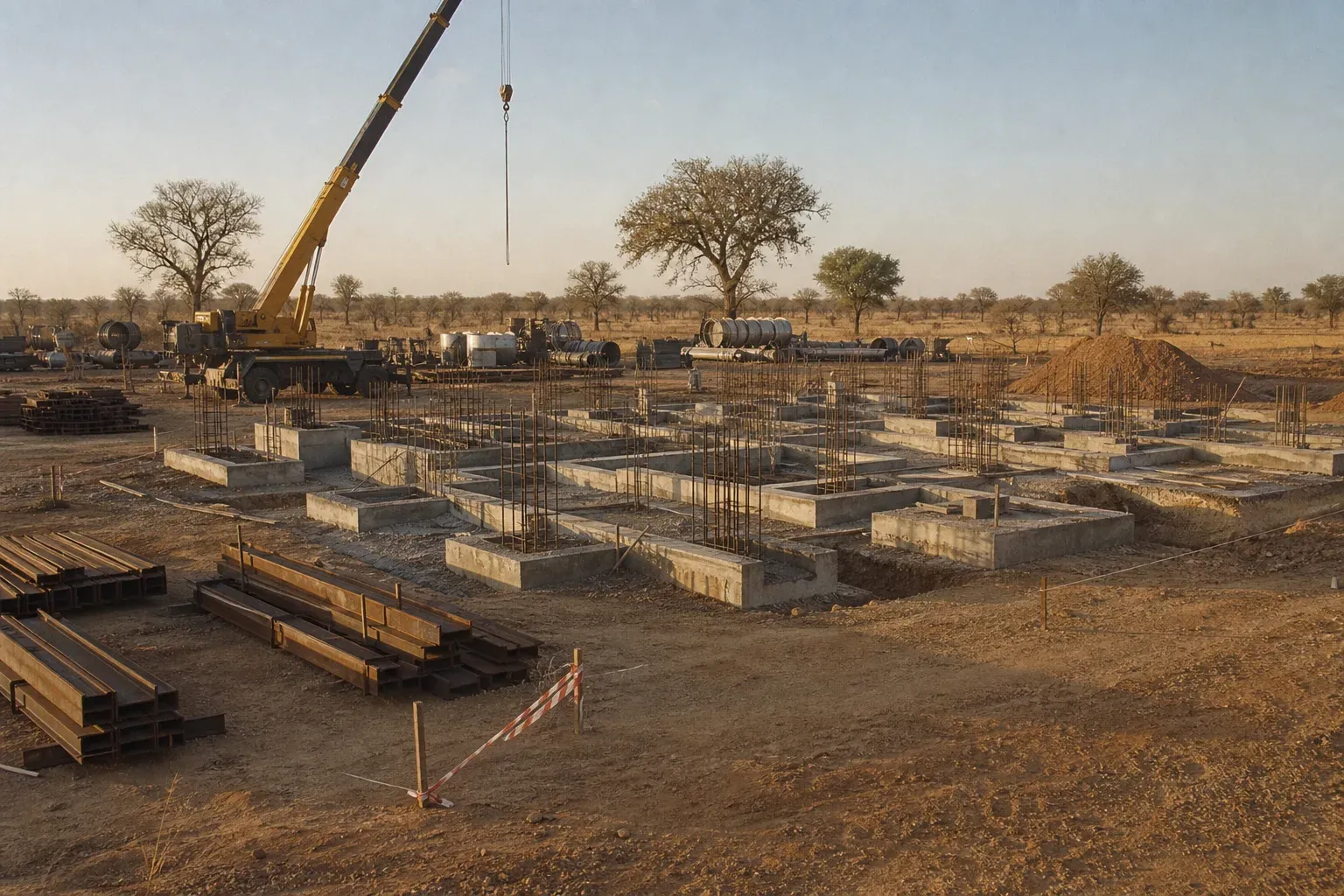
Overview
Bagoé is the group’s principal growth project and the asset that replaces the ounces Asankran will stop producing in the 2030s. It sits in the Savanes district of northern Côte d’Ivoire, on the same Birimian greenstone terrane that hosts Ghanaian gold production 400 kilometres to the east but with a fraction of the exploration history.
The definitive feasibility study, completed in October 2025, describes a conventional open pit mine feeding a 2.1 Mtpa carbon-in-leach plant, producing an average of 128 thousand ounces a year over a nine-year life, with 148 thousand ounces a year in the first five years while the higher-grade starter pits are mined.
The mining permit was granted in 2025 and the environmental and social impact assessment approved in the same year. A final investment decision is expected in 2026 following completion of project financing.
Definitive feasibility study outcomes
| Parameter | Value |
|---|---|
| Ore reserve | 18.6 Mt at 1.94 g/t for 1.16 Moz |
| Mineral resource (M&I) | 31.2 Mt at 1.78 g/t for 1.79 Moz |
| Processing rate | 2.1 Mtpa |
| Metallurgical recovery | 94.2% |
| Life of mine | 9 years |
| Average annual production | 128 koz (148 koz in years 1–5) |
| Strip ratio | 5.8:1 |
| Pre-production capital | US$412 million |
| All-in sustaining cost | US$1,010/oz |
| Payback period | 2.6 years |
Feasibility study outcomes are estimates. Actual results may differ materially. The study was prepared by an independent engineering firm with Competent Person sign-off on the reserve estimate.
Geology and exploration upside
Mineralisation at Bagoé occurs in a sheared and altered volcano-sedimentary sequence, with gold associated with quartz-albite-carbonate alteration and disseminated sulphide. Four deposits have been defined along an 11-kilometre corridor, of which three are included in the reserve.
Metallurgical testwork confirms the ore is non-refractory with fast leach kinetics and a 94.2% recovery at a 75-micron grind, which is a materially simpler flowsheet than Asankran and the main reason the projected all-in sustaining cost is US$138 per ounce lower.
The permit package covers 1,120 square kilometres of which less than 8% has been systematically drilled. Twelve untested geochemical and geophysical targets sit within trucking distance of the planned plant. The reserve underwrites the investment decision; the district is the reason the group took the ground in the first place.
How we are building it
Bagoé is being executed under an owner-managed delivery model with an engineering, procurement and construction management contractor, rather than a lump-sum turnkey contract. That decision reflects hard-won experience: the group’s slowest and most expensive build, the 2008 Asankran expansion, was a fixed-price contract that ended in eleven months of claims.
The plant design is deliberately conventional. There is no novel process technology, no first-of-a-kind equipment and no scale-up risk from pilot to full size. Every major unit operation has a directly comparable reference installation the project team has visited.
Early works, which begin after the final investment decision, cover the access road, the accommodation village, the water storage dam and the power line. Bulk earthworks and concrete follow six months later, allowing the first wet season to be absorbed by low-risk activities.
Environmental and social commitments
The approved impact assessment carries binding conditions. These are the commitments the group has made publicly and will report against quarterly during construction.
- No physical resettlement of households. The plant site and pit shells were moved twice during study work specifically to avoid it; 63 hectares of farmland will be economically displaced and compensated at full replacement value plus a 20% disturbance allowance.
- A lined tailings storage facility with a downstream raise design, an Engineer of Record appointed before construction and an independent tailings review board seated from first design review — not from first fill.
- A 32 MW solar and storage installation built as part of the initial plant rather than retrofitted, targeting 54% renewable electricity from the first year of production.
- Local employment floor of 90% Ivorian nationals in operations and 60% recruited from the Savanes district, with a training centre opened 18 months before first gold.
- A closure plan and fully funded closure provision in place at first production, not at first profit.
Outlook
The critical path to first gold runs through project financing, early works mobilisation in 2026 and plant commissioning in mid-2028. The group is targeting a debt component of no more than 45% of capital cost, consistent with its conservative balance sheet policy.
Bagoé will take group gold production above 340 thousand ounces a year in its first full year, and will shift the portfolio’s revenue mix back towards precious metals at a point in the cycle when copper capital intensity is at historic highs.
Asset history
How Bagoé got here
- 2020
Quintel acquires four exploration permits covering 1,120 km².
- 2022
Maiden mineral resource of 1.7 Moz declared.
- 2024
Pre-feasibility study completed; environmental and social impact assessment lodged.
- 2025
Definitive feasibility study completed; mining permit granted; ESIA approved.
- 2026
Final investment decision and start of early works planned.
- 2028
First gold targeted in the second half of the year.
Reporting standard
Mineral resources and ore reserves for this asset are estimated in accordance with the JORC Code (2012) and reviewed annually by an independent Competent Person. Resources are reported inclusive of reserves. Production figures are as reported in the FY2025 Annual Review.
Full resource and reserve statementLocation
Where this asset sits in the portfolio
Schematic map. Marker positions indicate the operating district, not a licence boundary.
- Producing
- Development
- Exploration
- Mbengwe Copper ComplexCopperbelt Province, Zambia · CopperProducing
- Lubumba Copper-Cobalt OperationLualaba Province, Democratic Republic of the Congo · Copper, CobaltProducing
- Asankran Gold MineWestern North Region, Ghana · GoldProducing
- Tazoult Silver MineAnti-Atlas, Drâa-Tafilalet, Morocco · SilverProducing
- Gamagara Manganese MineNorthern Cape, South Africa · ManganeseProducing
- Nyanga Manganese OperationHaut-Ogooué Province, Gabon · ManganeseProducing
- Fatala Bauxite OperationBoké Region, Guinea · BauxiteProducing
- Bagoé Gold ProjectSavanes District, Côte d'Ivoire · GoldDevelopment
- Erongo Copper ExplorationErongo Region, Namibia · CopperExploration
Seven operating mines, two development assets and 9 offices across nine countries. Every operation is managed by Quintel; we do not hold non-operated minority interests.
Enquiries
Questions about Bagoé?
Community, procurement, media and offtake enquiries relating to this operation route to a named contact in the country where it operates.