
Our story
Thirty years, five commodities and no transformational acquisition.
Quintel has never bought its way into a new business. Every asset in the portfolio was either found by the group or bought inexpensively from someone who could not make it work. This is how that happened, decade by decade.
- Incorporated
- 1996
- First mining lease
- 1999
- First gold poured
- 2002
- Operating mines today
- 7
In September 1996, Helena Marchetti and Kwabena Osei-Bonsu registered a company in London with two employees, one leased office and no assets. She had spent eleven years on a physical metals desk in Rotterdam. He was a metallurgist who had spent his career in Ghanaian gold plants. The business plan was to buy West African concentrate and place it with European smelters, and for the first two years that is exactly what the company did.
The turn came in 1997, when the partnership was retained to audit the metallurgy of a failing Ghanaian gold plant. The fee was modest. The lesson was not: the plant was losing eleven percentage points of recovery to a problem that could be fixed for the cost of a month’s trading margin, and nobody with the authority to fix it understood it. Both founders came away with the same conclusion, which is that in mining the money is made and lost in the process plant, and that a trading company will always be at the mercy of people who do not know what they are sitting on.
Two years later Quintel mortgaged its trading book to fund a drilling programme on a Ghanaian lease that two larger companies had already relinquished. That decision is the reason the company exists in its present form, and it is worth being honest about the odds: it could as easily have ended the company as founded it.
1996 – 2001
A trading desk that wanted to own the mine
Quintel began as a two-person minerals trading partnership in London, buying and placing West African concentrate. Within three years it had decided that the margin, and the responsibility, sat upstream.
- 1996Group
Quintel Corporation Limited is incorporated in London
Helena Marchetti, a physical metals trader, and Kwabena Osei-Bonsu, a Ghanaian metallurgist, register a minerals trading partnership with two employees and a leased office. The first year’s business is placing West African tin and manganese concentrate with European smelters.
- 1997Group
First technical mandate
The partnership is retained to audit the metallurgy of a failing Ghanaian gold plant. The work pays modestly and teaches the founders a lesson that shapes the company: the money in mining is made or lost in the process plant, not on the trading floor.
- 1999Growth
First mining lease granted
Quintel is granted a mining lease over the Asankran prospect in Ghana’s Western Region — ground two larger companies had relinquished as sub-economic. The company mortgages its trading book to fund the drilling programme.
2002 – 2010
One mine, then a second country
Asankran poured first gold in 2002 and funded everything that followed. The dormant Mbengwe licences in Zambia were acquired in 2004 and produced first copper in 2007.
- 2002Operations
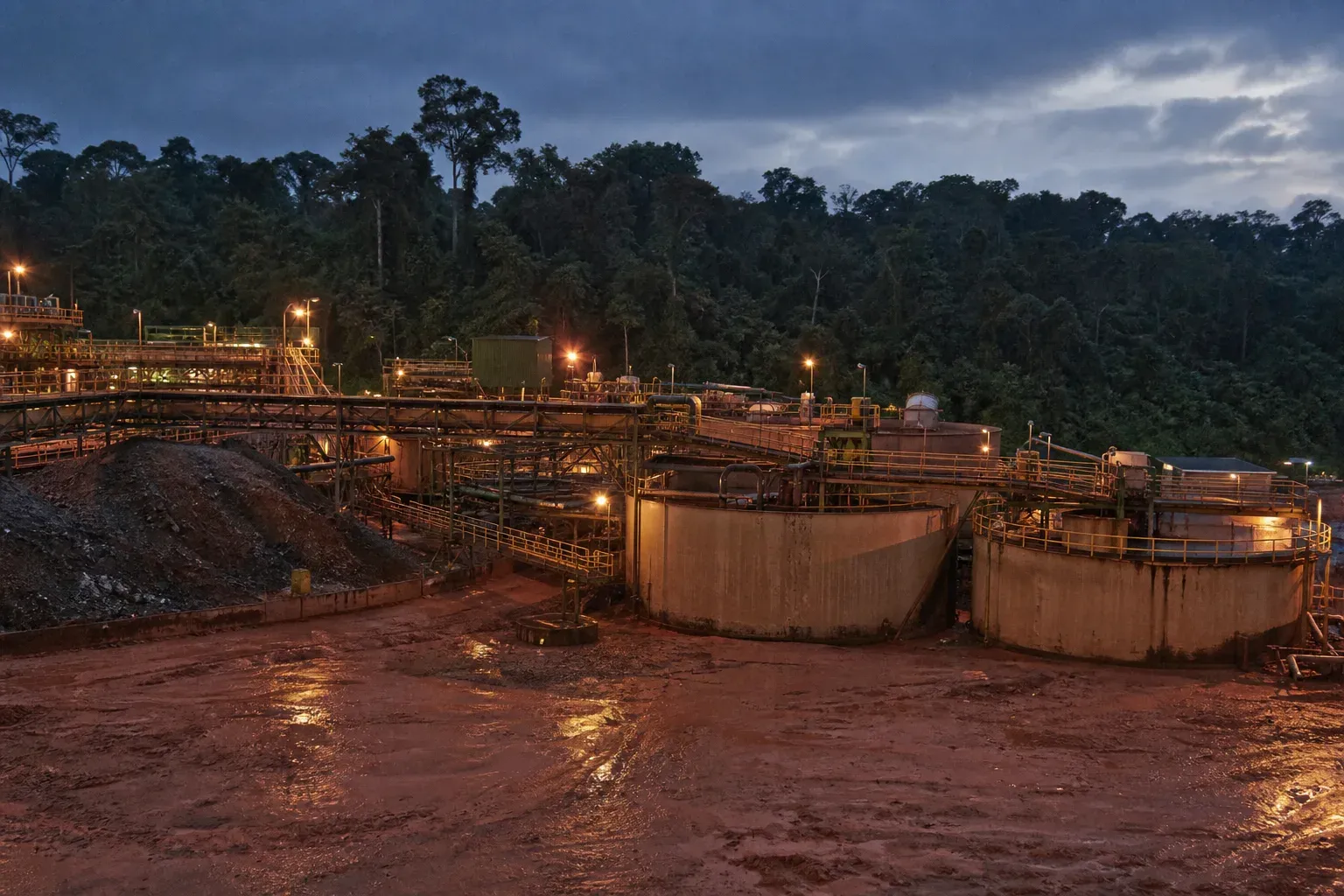
First gold poured at Asankran
A 1.2 Mtpa carbon-in-leach plant is commissioned eleven weeks late and 6% over budget. The first pour produces 412 ounces. Asankran has not stopped producing since.
- 2004Growth
Entry into Zambia
Quintel acquires the dormant Mbengwe copper licences in the Zambian Copperbelt for a modest cash consideration and a binding commitment to rehabilitate legacy waste dumps left by three previous operators.
- 2007Operations
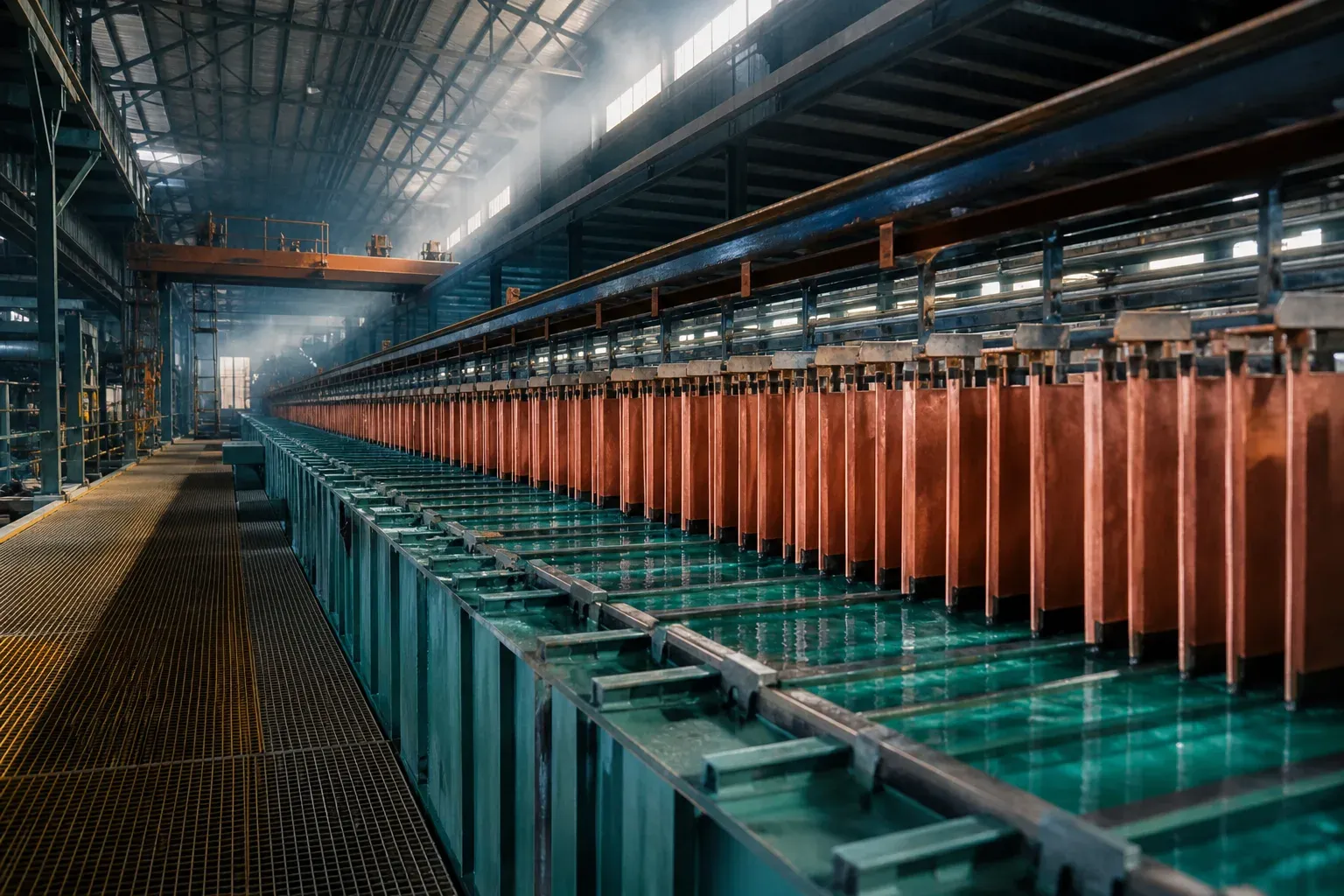
First copper cathode
A 45 ktpa solvent extraction and electrowinning plant at Mbengwe produces the group’s first copper, from oxide material earlier owners had classified as waste.
- 2008Operations
A hard lesson in contracting
The Asankran plant expansion to 2.8 Mtpa is delivered under a lump-sum turnkey contract and ends in eleven months of claims. The group has used owner-managed delivery with an engineering and construction management contractor on every project since.
- 2009Responsibility
United Nations Global Compact participant
Quintel signs the Global Compact and publishes its first standalone sustainability report, covering safety, water, emissions and community spend across two operations.
2011 – 2018
Diversification, and the discipline it required
Entry into the DRC, South Africa and Gabon took the group from two commodities to four. The 2015 price collapse tested whether the balance sheet policy written in the good years would hold.
- 2011Growth
Entry into the Democratic Republic of the Congo
After two years of legal, title and human rights due diligence, the group acquires a majority interest in the Lubumba copper-cobalt licences in Lualaba Province.
- 2012Operations
Mbengwe concentrator commissioned
The sulphide horizon beneath the Mbengwe oxide cap is unlocked by a new concentrator, transforming a medium-life leach operation into the group’s cornerstone asset.
- 2013Growth
Entry into South Africa
Quintel acquires 74% of Gamagara in the Kalahari Manganese Field alongside a broad-based black economic empowerment consortium and an employee share trust holding the remaining 26%.
- 2015Group
The copper price collapse
Copper falls below US$2.00 a pound. The group suspends discretionary capital, cuts board and executive pay by 20%, and completes the year without a single involuntary redundancy across the portfolio. The balance sheet policy written in 2012 — net debt below 1.5 times EBITDA through the cycle — holds and has never been relaxed since.
- 2016Growth
Entry into Gabon
The Nyanga manganese permit is acquired from a vendor that ran out of capital mid-construction. Quintel completes the plant on a revised design for less than the vendor had already spent.
- 2018Operations
Underground at Mbengwe and Asankran
Both flagship mines begin the transition from open pit to underground within eight months of each other, adding roughly a decade of mine life to each and permanently changing the group’s skills profile.
2019 – 2026
Succession, scale and the standard we are held to
A generational handover of leadership, the fastest project delivery in group history at Fatala, and the rebuilding of the group’s energy, tailings and water systems to standards that did not exist when most of these mines were designed.
- 2019Group
Succession
Kwabena Osei-Bonsu retires as Chief Executive after twenty-three years and is succeeded by Thandeka Mokoena, previously Chief Operating Officer. Helena Marchetti moves from Commercial Director to Non-Executive Chair. Both founders remain on the board.
- 2019Growth
Guinea: the Fatala mining convention
A mining convention is signed with the Republic of Guinea over the Fatala bauxite plateau in the Boké region, and construction begins in the same year.
- 2020Responsibility
Pandemic operating protocols
All six operations continue producing through the pandemic under isolation and rotation protocols developed with host country health authorities. The group funds oxygen plants at four regional hospitals; three remain in service today.
- 2021Operations
First bauxite shipment from Fatala
Fatala ships 62,000 tonnes twenty-six months after the convention was signed — the fastest project delivery in the group’s history and the longest-life asset in the portfolio.
- 2022Responsibility
Tailings governance rebuilt
Every tailings facility in the group is brought under a single conformance programme aligned to the Global Industry Standard on Tailings Management, with an Engineer of Record and an independent review board for each facility.
- 2023Responsibility
The energy programme
Solar plants are energised at Asankran and, the following year, at Mbengwe; the Lubumba grid connection is rebuilt in partnership with the national utility, cutting diesel consumption at that operation by 74% in two years.
- 2024Operations
Group production records
Copper passes 139 kt, bauxite passes 3.9 Mt and the group records zero fatalities for a fourth consecutive year.
- 2025Growth
Bagoé definitive feasibility study completed
The study on the Bagoé gold development in Côte d’Ivoire is completed and the mining permit granted, defining a 1.16 Moz reserve and a US$412 million build. Group revenue reaches US$2.94 billion.
- 2026Growth
Tazoult acquired: a fifth commodity and a first step outside sub-Saharan Africa
Quintel acquires 75% of the Tazoult silver mine in the Moroccan Anti-Atlas for US$318 million in cash, adding roughly 4.1 Moz of annual silver production, a seventh operating mine and an unresolved water dispute the group commits to reopening rather than inheriting quietly.
- 2026Group
Thirty years
Quintel enters its thirtieth year with seven operating mines, two development assets, 9,500 people across nine countries and reserves supporting an average seventeen years of production.
What thirty years actually taught us
Four lessons have survived contact with reality often enough to have become policy rather than opinion.
Cheap assets are cheap for a reason, and the reason is usually fixable
Asankran, Mbengwe and Nyanga were all acquired from parties who had failed with them. In each case the problem was technical and specific: a metallurgical flowsheet designed for the wrong ore, an oxide cap treated as the deposit rather than as its lid, a plant half-built to a design that could not work. None of them required a discovery. All of them required someone to read the drill logs properly.
The balance sheet is written in the good years and read in the bad ones
The 1.5 times net debt to EBITDA limit was set in 2012, when copper was above US$3.50 and every competitor was gearing up. It looked conservative to the point of timidity for three years. In 2015 it was the reason Quintel did not have to sell an asset, cut exploration to zero, or make a single involuntary redundancy while others did all three.
You cannot subcontract the consequences
The 2008 lump-sum turnkey contract at Asankran ended in eleven months of claims and a plant that took two years to reach nameplate. The contract transferred risk on paper and none of it in practice, because the party that actually lives with a badly built plant is the party that has to operate it for twenty years. Every project since has been owner-managed.
Consent is a relationship, not a document
The reason the 2016 resettlement at Asankran was completed without litigation is that the chief who negotiated it had been dealing with the same company, and largely the same people, since 1999. Where Quintel has moved fast into a new jurisdiction, as at Fatala, the group has had to buy that trust with performance instead of history, and it is slower, more expensive and less certain.