
Western North Region, Ghana
Asankran Gold Mine
The founding asset of the group and the first mine Quintel ever built. Asankran has produced gold continuously since 2002 and remains the operation against which every other asset in the portfolio is benchmarked.
- FY2025 gold
- 212.4 koz
- Ore reserve
- 2.54 Moz @ 2.31 g/t
- AISC
- US$1,148/oz
- Producing since
- 2002
Overview
Asankran is where Quintel became a mining company rather than a trading house. The prospect was acquired in 1999 as an exploration lease that two larger companies had walked away from, on the argument that the grade was too low and the pit too shallow. Both were right about the starting pit. Both underestimated what lay beneath it.
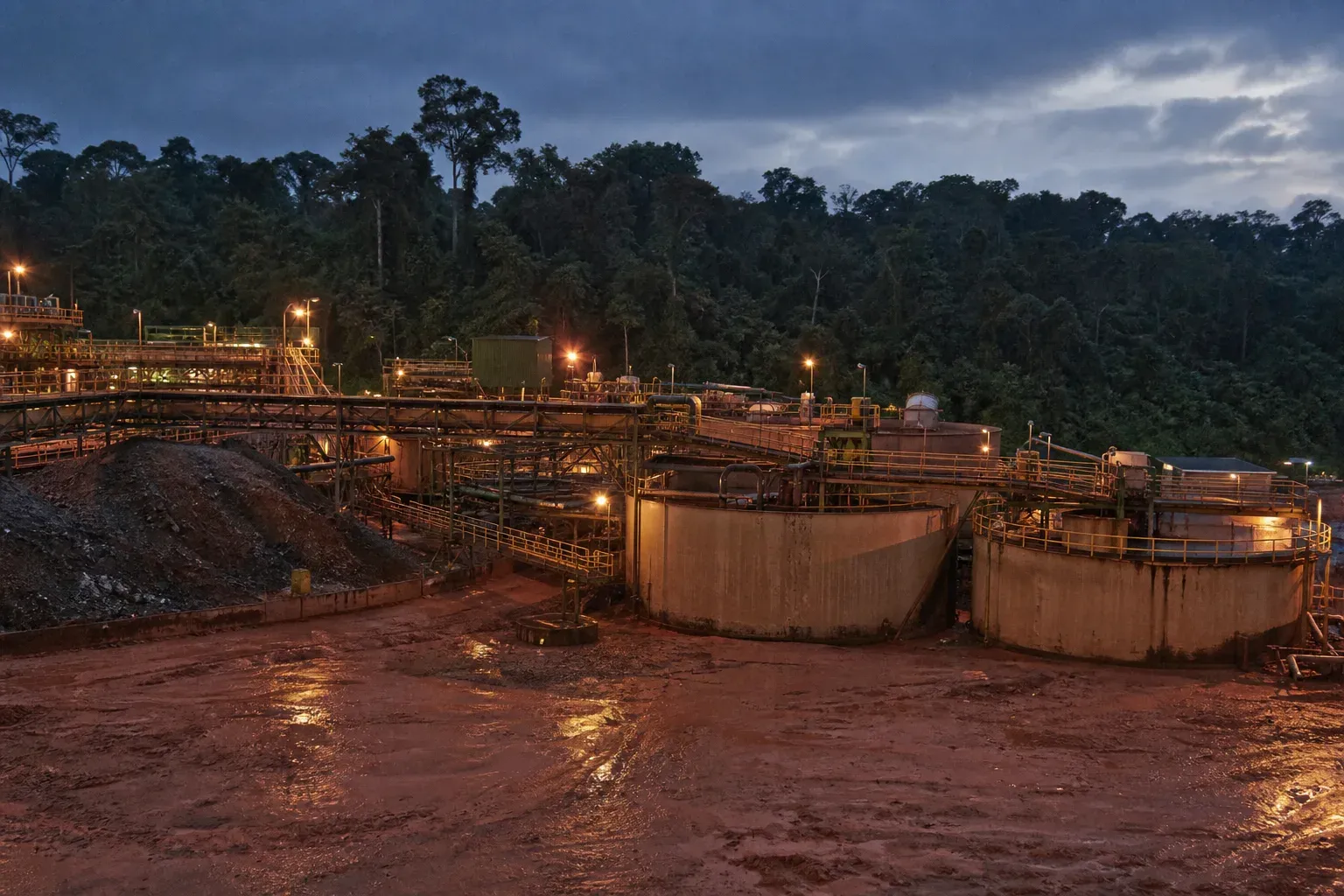
The mine has produced gold continuously since 2002 and passed three million cumulative ounces in 2025. It operates as an integrated open pit and underground complex feeding a 4.2 Mtpa carbon-in-leach plant, and produces doré bars on site that are refined under contract at an LBMA Good Delivery refinery.
FY2025 production was 212.4 thousand ounces at an all-in sustaining cost of US$1,148 per ounce, placing Asankran comfortably in the second cost quartile globally. The mine directly employs 1,320 people; 99% are Ghanaian and 71% are recruited from the Western North Region.
Geology and resource
Asankran sits in the Sefwi-Bibiani greenstone belt, a Palaeoproterozoic Birimian terrane that hosts the majority of Ghanaian gold production. Mineralisation is structurally controlled, associated with a shear zone developed along the contact between metavolcanic rocks and a felsic intrusive body, with gold occurring as free grains and in association with arsenopyrite and pyrite in quartz-carbonate veining.
The deposit has been drilled over 4.8 kilometres of strike to a vertical depth of 940 metres, with 1.02 million metres of drilling in the database. The high-grade shoot plunges shallowly to the north-east and remains open; it is this plunge continuity, not the near-surface tonnage, that underwrites the mine life.
Approximately 18% of the ore is refractory, hosted in sulphide with gold locked in arsenopyrite. This material is currently stockpiled rather than treated, pending the outcome of a study into an ultra-fine grinding and oxidation circuit due to report in 2027.
Mineral resources and ore reserves
| Category | Tonnes (Mt) | Grade (g/t Au) | Contained gold (koz) |
|---|---|---|---|
| Proved reserve | 19.4 | 2.44 | 1,522 |
| Probable reserve | 14.8 | 2.14 | 1,018 |
| Total ore reserve | 34.2 | 2.31 | 2,540 |
| Measured and indicated resource | 61.0 | 2.05 | 4,020 |
| Inferred resource | 18.4 | 1.88 | 1,112 |
Reserves estimated at a gold price of US$1,750/oz. Open pit cut-off grade 0.62 g/t; underground cut-off grade 1.85 g/t.
Mining
Two open pits remain active. The original Asankran pit is in its final cutback and will be exhausted in 2029, after which it will be used as an in-pit tailings and water storage facility, avoiding the construction of a new surface facility entirely. The satellite Nkwanta pit, opened in 2016, provides blending flexibility with softer, higher-recovery oxide ore.
Underground mining accounts for 46% of milled tonnes and 63% of contained ounces. The mine uses long-hole open stoping with cemented rockfill in the primary stopes and unconsolidated waste fill in secondaries. Development advanced 8,120 metres in FY2025.
Ground conditions in the shear zone are variable and seismically active below 600 metres. Asankran runs a 14-station microseismic monitoring array, an exclusion protocol following events above magnitude 1.5, and dynamic ground support in all development below the 620 level. Two seismic events in 2024 caused localised damage; neither resulted in injury because the exclusion protocol had already cleared the area.
Processing and product
The plant is a conventional three-stage crushing, SAG and ball milling, gravity recovery and carbon-in-leach circuit with a nameplate capacity of 4.2 Mtpa. A Knelson gravity circuit recovers 34% of gold ahead of leaching, which reduces cyanide consumption and shortens residence time. Overall recovery averaged 93.1% in FY2025 on non-refractory feed.
Cyanide is managed under the International Cyanide Management Code, to which the operation has been certified since 2011 with recertification audits every three years. Detoxification uses the SO₂/air process, and weak-acid-dissociable cyanide in tailings discharge is maintained below 30 mg/l against a Code limit of 50 mg/l; the FY2025 average was 11 mg/l.
Doré bars average 82% gold and 14% silver and are exported under insured transport to a Good Delivery refinery in Switzerland. Refined gold is sold at the LBMA afternoon price on the day of allocation; Quintel does not run a strategic gold hedge book.
Operating performance
| Metric | FY2023 | FY2024 | FY2025 |
|---|---|---|---|
| Ore milled (Mt) | 3.9 | 4.1 | 4.2 |
| Head grade (g/t Au) | 1.72 | 1.74 | 1.79 |
| Recovery (%) | 92.4 | 92.8 | 93.1 |
| Gold produced (koz) | 198.1 | 204.9 | 212.4 |
| AISC (US$/oz) | 1,214 | 1,181 | 1,148 |
| Underground share of ounces (%) | 54 | 59 | 63 |
Energy, water and environment
Asankran operates in high-rainfall tropical forest margin, which makes water management — having too much of it, not too little — the defining environmental challenge.
- Power: grid supply from the Ghanaian hydro-dominated system supplemented by a 28 MW solar plant commissioned in 2023; renewables and hydro together cover 84% of site electricity.
- Water: the site is a net water exporter in the wet season. Stormwater is separated from contact water, and contact water is stored, treated and reused. Zero uncontrolled discharge events have been recorded since 2017.
- Biodiversity: the lease abuts a forest reserve. A 340-hectare biodiversity offset area, managed with the Forestry Commission and two community land committees, has recorded net gains in canopy cover in each of the last six annual surveys.
- Rehabilitation: 610 hectares rehabilitated to date, with an independently reviewed closure provision of US$96 million fully cash-backed in a Ghanaian reclamation bond.
- Emissions: Scope 1 and 2 emissions of 96 kt CO₂e in FY2025, down 44% from the 2019 baseline on a per-ounce basis.
Community and contribution
Asankran paid US$118 million in taxes, royalties and statutory payments in FY2025. Ghana’s mineral royalty regime directs a share of royalties back to district assemblies and traditional authorities in the mining area; Quintel publishes those flows alongside its own community spend so that residents can see both.
The mine has an unusual asset in its relationship with the surrounding communities: time. Twenty-six years of continuous presence means the current chief negotiated with Quintel as a young man, and a significant proportion of the workforce are children of the first cohort hired in 2001. That history is why the resettlement of 148 households for the Nkwanta pit in 2016 was completed without litigation — and why the group applies the same negotiated, compensation-above-statutory model everywhere else.
The Asankran Skills Institute, opened in 2011, trains 220 students a year in mechanical fitting, electrical, welding and heavy equipment operation. It is open to non-employees and 54% of graduates take jobs outside the mine.
Outlook
Guidance for FY2026 is 205–220 thousand ounces at an all-in sustaining cost of US$1,120–1,180 per ounce. Grade is expected to remain broadly flat as the higher-grade underground share offsets declining open pit grades.
Two studies will shape the mine after 2030: the refractory treatment study, which if successful would add an estimated 480 thousand ounces to reserves from existing stockpiles, and the deep extension drilling programme below the 940 metre level, where the plunge remains untested.
Asset history
How Asankran got here
- 1999
Quintel is granted its first mining lease, over the Asankran prospect.
- 2002
First gold poured from a 1.2 Mtpa CIL plant.
- 2008
Plant expanded to 2.8 Mtpa; second pit opened.
- 2015
Underground feasibility study completed on the down-plunge extension.
- 2019
Underground first stope ore; plant expanded to 4.2 Mtpa.
- 2023
Site converted to a majority-renewable power supply.
- 2025
Mine passes three million ounces of cumulative gold production.
Reporting standard
Mineral resources and ore reserves for this asset are estimated in accordance with the JORC Code (2012) and reviewed annually by an independent Competent Person. Resources are reported inclusive of reserves. Production figures are as reported in the FY2025 Annual Review.
Full resource and reserve statementLocation
Where this asset sits in the portfolio
Schematic map. Marker positions indicate the operating district, not a licence boundary.
- Producing
- Development
- Exploration
- Mbengwe Copper ComplexCopperbelt Province, Zambia · CopperProducing
- Lubumba Copper-Cobalt OperationLualaba Province, Democratic Republic of the Congo · Copper, CobaltProducing
- Asankran Gold MineWestern North Region, Ghana · GoldProducing
- Tazoult Silver MineAnti-Atlas, Drâa-Tafilalet, Morocco · SilverProducing
- Gamagara Manganese MineNorthern Cape, South Africa · ManganeseProducing
- Nyanga Manganese OperationHaut-Ogooué Province, Gabon · ManganeseProducing
- Fatala Bauxite OperationBoké Region, Guinea · BauxiteProducing
- Bagoé Gold ProjectSavanes District, Côte d'Ivoire · GoldDevelopment
- Erongo Copper ExplorationErongo Region, Namibia · CopperExploration
Seven operating mines, two development assets and 9 offices across nine countries. Every operation is managed by Quintel; we do not hold non-operated minority interests.
Enquiries
Questions about Asankran?
Community, procurement, media and offtake enquiries relating to this operation route to a named contact in the country where it operates.